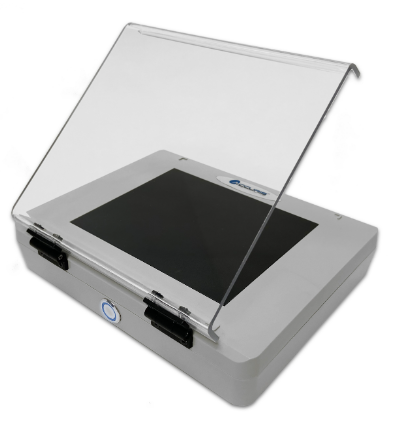
Accuris UV Transilluminators

SKU: E3000~ea

Accuris UV Transilluminators

SKU: E3000~ea
Style
Regular price $1,542.66 CAD
/
  • Secure payments
Shipping calculated at checkout.

Accuris UV Transilluminators


 Accuris™ UV Transilluminators feature space-saving designs, to fit perfectly in any busy laboratory. Two models are available, our standard E3000 and new E3100 myView compact model.  Choose your model depending on your application and the size or number of gels to analyze.

  • 302nm midrange UV wavelength
  • Optimal for EtBr, SmartGlow, or SYBR stained nucleic acids
  • E3000 models offers dual intensity settings (50% or 100%)
  • Hinged UV safety cover
  • Use with SmarDoc enclosure for gel imaging with a smart phone

E3100 myView Compact UV Transilluminator

The myView’s four 6W bulbs coupled with a reflector system and special diffusing filter glass provide exceptional uniformity across the viewing surface. This allows for quantification of DNA and also higher quality imaging when using a camera system.

Users are protected by harmful effects of UV radiation by the hinged, UV blocking safety cover. Two friction hinges on the front edge of the cover allow for easy adjustment of the cover angle. Position the cover horizontally for general viewing, tilt it at an angle for gel access and band cutting, or
fully open to use the SmartDoc ™ Imaging Enclosure and filters (sold separately) for gel imaging with a smartphone.  Use filter E5001-UVBLOCK for best results when imaging SmartGlow, SYBR or ETBR stained gels.

The myView™ Transilluminator has a surprisingly small footprint (smaller than a standard piece of paper). However, the viewing surface is large enough to accommodate a mid-sized gel or multiple smaller gels. The 16.5 x 13.5 cm filter glass is scratch resistant to allow band excision with a metal
blade.

E3000 UV Transilluminator

The E3000 features a space-saving design, with a width of only 10.5 inches, to fit perfectly in any busy laboratory. However, the 16 x 19 cm UV viewing surface is sized to accommodate large gels or multiple smaller gels. The illuminated surface is comprised of a special black glass which is easy to clean, durable and scratch resistant.

An array of 4 high intensity UV bulbs coupled with an optimized filter provides even illumination across the viewing surface and allows detection of small sample quantities. The dual intensity switch can be used to lower the UV intensity to 50% to reduce DNA damage during long exposure times, or switch to high intensity (100%) for viewing weak fluorescent signals or for photo documentation.

The acrylic UV blocking cover allows safe viewing of samples and has two friction hinges on the front edge to allow angling of the cover for gel access. The cover can be positioned to 90° (straight up) to fit a gel imaging hood, such as the Accuris SmartDoc™ imaging enclosure.

Optional SmartBlue™ Plus Viewing Glasses

SmartBlue Plus Viewing Glasses is the perfect accessory for gel imaging and precise band cutting for both UV transilluminators. Composed of UV-blocking polycarbonate and tinted orange for blocking blue light, these glasses effectively protect against blue LED and UV light.

Specifications:

  MyView™ Compact UV Transilluminator UV Transilluminator
Light Source 4 x 6 UV Bulbs 4 x 8 UV Bulbs
Wavelength 302nm 302nm
Intensity Control - Low (50%) or High (100%)
Viewing Surface 16.5 x 13.5cm 16 x 19cm
External Dimensions 10 x 8 x 2.75 in/25 x 20 x 7 cm 10.5 x 13 x 5.5 in / 26.5 x 32.5 x 14 cm
Electrical 120V or 230V, 50/60Hz 120 or 230V, 50-60Hz
Warranty 2 Years 2 Years


Additional Literature:

UV Transilluminators


FAQ: 

  1. What is a UV transilluminator used for?
    A UV transilluminator is used to visualize DNA/RNA bands in electrophoresis gels by shining UV light through the gel so fluorescent stains become visible for viewing, documentation, and band excision.
  2. What UV wavelength is this unit (302 nm vs 365 nm)?
    This model uses [insert wavelength: e.g., 302 nm] UV, which is commonly used for strong fluorescence with many UV-reactive gel stains. If you need longwave UV (365 nm) or blue light, choose a different platform designed for that excitation.
  3. Will it work with ethidium bromide (EtBr)?
    Yes—UV transilluminators are standard for EtBr-stained gels. Always follow your lab’s safety procedures for UV exposure and EtBr handling.
  4. Will it work with SYBR Safe, GelGreen, SmartGlow, or other “safer” stains?
    Some “safer” stains are optimized for blue light, while others still work under UV. Check your stain’s recommended excitation source. If it specifies blue light, a blue-light transilluminator is typically the correct choice.
  5. What’s the difference between the Accuris E3000 and E3100 MyView?
    E3000 is typically chosen when you want more control (including intensity control, depending on model configuration) and a larger work surface. E3100 MyView is typically chosen when you want a compact footprint for routine gel viewing with strong uniformity.
  6. Is dual intensity useful? When should I use lower intensity?
    Lower intensity is useful when you want to reduce UV exposure to the sample (especially if you plan downstream work). Higher intensity is useful for faint bands, thicker gels, or when visibility is the priority.
  7. Can I use this for band excision (gel cutting)?
    Yes. UV transilluminators are commonly used for band excision. Best practice is to minimize exposure time, use UV protection, and work efficiently to reduce UV-related damage to nucleic acids.
  8. What safety precautions are required?
    UV light can damage eyes and skin. Use a UV-blocking shield/cover, UV-rated eyewear, and minimize exposure time. Follow your lab’s SOPs and restrict use to trained staff.
  9. Does it include a UV shield or safety cover?
    included
  10. Can I use it with a gel documentation system or camera hood?
    Often yes. Many labs pair UV transilluminators with gel doc hoods/enclosures.
  11. What are the power requirements for Canada (120V)?
    120V/60Hz 
  12. Do you ship across Canada and can I purchase by PO?
    Yes
  13. What warranty and service support is available in Canada?
    2-year warranty supported by Cambridge service. 


  14. What’s the typical lead time in Canada?
     2–4 week 
  15. Will UV exposure affect downstream applications like cloning or PCR?
    Extended UV exposure can damage nucleic acids. If downstream work matters, use the lowest effective intensity, minimize exposure time, and consider stains/workflows that reduce UV exposure.
  16. How do I optimize for faint bands?
    Use the appropriate stain concentration, confirm the correct excitation source for your dye, reduce background fluorescence, and use higher intensity only when required for visibility.
  17. Is this suitable for routine molecular biology workflows?
    Yes, for UV-reactive gel stains and standard electrophoresis workflows. If your lab uses blue-light-only stains, a blue-light unit is typically the better match.
  18. Is this suitable for teaching labs and student use?
    Yes, provided your lab enforces UV safety controls (shield/cover, eyewear, supervision, and training). Teaching labs should prioritize clear safety controls and durable handling.
  19. What’s the simplest setup for a teaching lab?
    A UV transilluminator with a UV shield plus a basic imaging method (phone + enclosure or a gel doc hood) is typically the simplest. The key is consistent safety procedures and repeatable imaging.
  20. Is a UV transilluminator used in industrial QC?
    It can be, particularly in biotech, food, and environmental labs that run electrophoresis-based checks. The key is repeatability, documentation, and clear SOP alignment.
  21. Can you support documented workflows and repeatable results?
    Yes—pairing the unit with a standardized imaging enclosure/gel doc workflow supports repeatability and easier recordkeeping.
  22. Can you support compliance-style purchasing (POs, documentation, traceability)?
    Yes


Recently viewed